Schlagworte: Ausstellung
Jahr: 2007

»109 Yds«

image
  • Polyesterbänder, Aluminium,
  • Edelstahlseile
  • 410 x 10043 x 503 cm
  • »Neue Freunde
  • Aktuelle Positionen zum Quadrat«
  • Museum Ritter
  • Waldenbuch
  • 28.10.2007 - 20.4.2008

Seit Michael Reiter (1952 in München geboren) sich 1993 von der Malerei abwandte, indem er einen Keilrahmen mit Leinwand bespannte und sich entschied, es dabei zu belassen, ist Spannung die dominante Dimension seiner Kunst. Spannung ist ein ebenso allgemeines Phänomen wie etwa Gewicht, Entfernung, Schatten, Wachstum oder Zerfall. Doch die Abkehr von der Malerei geschah nicht abrupt, sondern langsam und reflektiert: Der Künstler spannte farbige Bänder, die an die ehemalige Leinwand erinnern, horizontal über die Wand und dann auch übereck. Nun spannt er potenziell endlose Bänder, die das begrenzte Rechteck der Malfläche überwinden, quer durch den Raum.

Bei dem mit Nägelchen wie flüchtig an die Wand gepinnten geometrischen Gebilde aus farbigen Bändern - eine Arbeit, die das MUSEUM RITTER kürzlich erworben hat - handelt es sich um ein gevierteltes Quadrat, das sich in ungewohnter Parallelperspektive zum Abbild eines gerasterten, verzerrt erscheinenden Würfels erweitert: der Scheinkubus heißt »Container«. Die Bänder stehen senkrecht zur Wand und betonen das reliefartige Vorkragen in den Raum. Sie wirken in Aufsicht wie eine Zeichnung, ein Gitter aus Buntstiftstrichen, und zeigen - wie changierend - ihre Breite erst, wenn man zur Seite tritt. Die herunterbaumelnden bunten Nähfädchen erinnern an das Träufeln der Farbe. Unübersehbar ist die Farbabstrahlung auf die weiße Wand. Wo ein Schatten entsteht, ist er farbig.
»Container« markiert einen Übergang von der Malerei in den Raum. Darüber hinaus zeigt die Arbeit eine Abkehr von den Irrationalismen der Malerei und eine Hinwendung zur Geometrie, dem allgemeinen rationalen Code der Menschheit, welcher Kunst, Architektur, Technik und den Weltraum mit der Symmetrie des menschlichen Körpers verbindet. Doch hat der Künstler sich keineswegs festgelegt: Es gibt auch Bänder, die - im Zickzack gespannt - an das Gestische der informellen Malerei erinnern, das heißt an eine emotionsgesteuerte Bewegung.
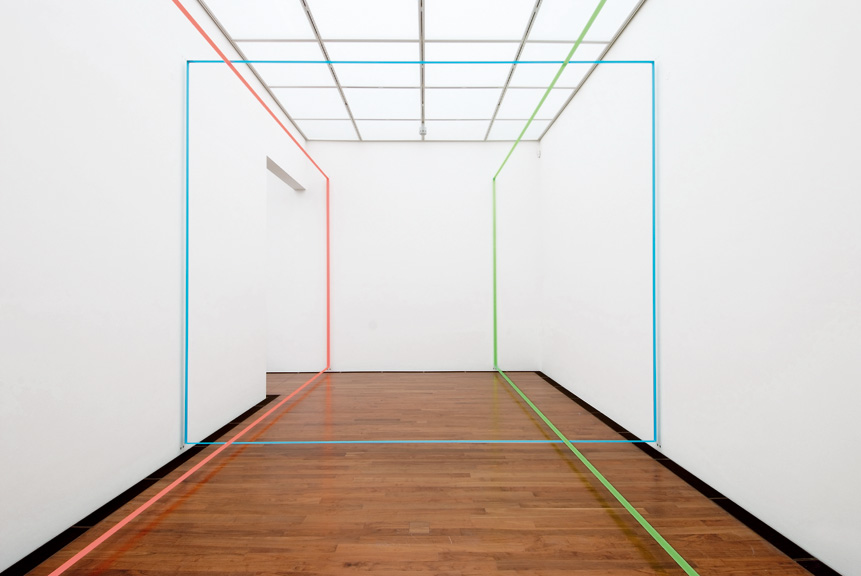
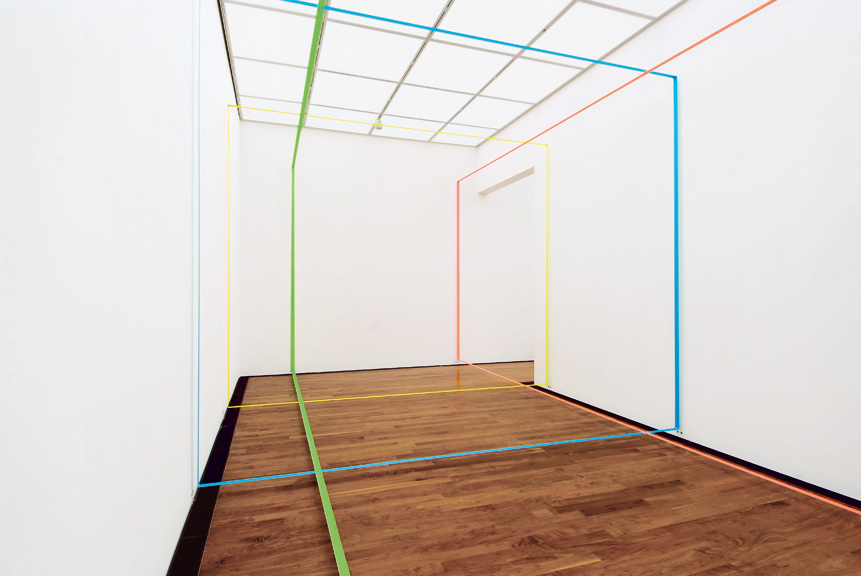
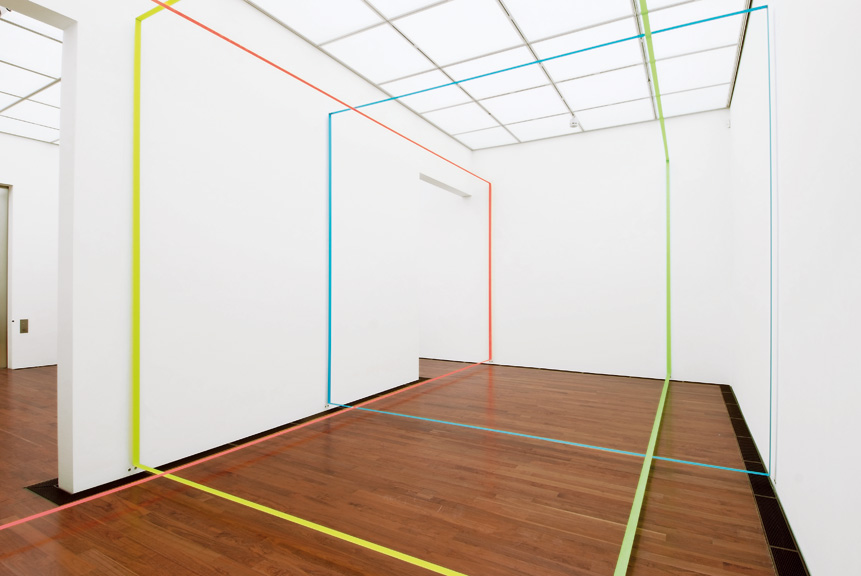
Reiter hat nun aus dieser Wandarbeit eine stereometrische Raumverspannung entwickelt: Die vier einander rechtwinklig kreuzenden farbigen Endlosbänder in Gelb, Blau, Grün und Rosa markieren einen Raum im Raum, einen quaderförmigen magischen Bezirk, den der Betrachter - anders als bei den begehbaren Platten von Carl Andre - nur betreten kann, wenn er eines der knöchelhoch gezogenen Bänder wie eine Schwelle überschreitet. Die Hemmung macht bewusst, wo man ist: mitten in der Kunst, die man hier nicht wie gewohnt von außen betrachtet. Man befindet sich nun wirklich in einem »Container«, denn die Bänder sind in der Art gespannt, wie Pakete professionell verschnürt werden: zwei Stahl- oder Kunststoffbänder über die Längsseite, zwei über die Querseite des Pakets.
Die skulpturale Dimension der Arbeit vermittelt sich durch die allseitige Einsichtigkeit, durch die Begehbarkeit der Bänderstruktur. Die gespannten Bänder bestimmen den Raum minimalistisch zurückgenommen, einfach und klar mit der ökonomischen Eleganz des »less is more«, sie sind raumgreifend und in ihrer linearen Leichtigkeit und heiteren Farbgebung anmutig. Die Anmut und die Kraft, die hinter der straffen Spannung steht, sind eine eher seltene Verbindung, die man sonst vom Tanz und der Akrobatik her kennt. Fred Sandbacks Fäden und Dan Flavins farbige Leuchtstoffröhren sind Paten dieser Kunst, die allerdings mit ihrem reflektierten Rückbezug auf die Malerei sowie mit der »Spannung« ihr eigenes Terrain behauptet. Die einfarbigen, zarten Bänder erscheinen hier licht, dort dunkler: Dieselbe Farbe wirkt durch Lichteinfall und Bewegung des Betrachters auf diesen sehr unterschiedlich - ein Aspekt der Minimal Art. Angesichts der Gespanntheit denkt man auch an die Gelöstheit der Bänder. Die mögliche Erschlaffung macht das Riskante der Spannung aus, die inhärente Instabilität. Es sind die luftigen Konstruktionen von Zelten, Schirmen und Drachen, die den Künstler inspirieren. Seine Skulpturen transportiert er zusammengerollt in einer Tasche. Das hat etwas vom Charme der Improvisation. Keine Konstruktion ist für immer.


Burkhard Brunn


109 Yds (mp3) Sprecherin:Marina Behnke

109Yds für Kinder (mp3)  Sprecherin: Elke Kollar

© 2007 tonwelt GmbH, Museum Ritter

Autor: Dr. Stephan Trescher


Ever since Michael Reiter (born 1952 in Munich) renounced painting in 1993 after stretching a canvas on a stretcher and deciding to leave it at that, tension has been the major dimension
in his art. Tension is an everyday phenomenon in much the same way as weight, for instance, or distance, shadow, growth, or decline. But his renunciation of painting was not an abrupt
affair, but slow and reflected: the artist stretched coloured bands-which recall the one-time canvas-horizontally over the wall and then also across a corner. And now he stretches a
potentially limitless number of bands criss-cross through space to go beyond the restricted rectangular surface of the canvas.

This geometrical configuration of coloured bands that has been pinned almost as if fleetingly to the wall with tiny nails-a work that MUSEUM RITTER has recently acquired-represents a quartered square which, in an uncustomary parallel perspective, extends to become the image of a framework square with a distorted appearance. This semblance of a cube is called »Container«. The bands run vertical to the wall, which emphasizes the relief-like way they loom into space. Viewed from above they look like a drawing, a grid made of coloured pencil lines, and only first reveal their breadth-and an almost iridescent appearance-when one steps to the side. The bright tumbling threads look like paint in the act of being poured, and the coloured light they reflect onto the white wall cannot be overlooked. Wherever a shadow is cast it is coloured.
»Container« marks a transition point in the move from painting into space. In addition, the work shows a clear renunciation of the irrationalities of painting and a turn to geometry, the universal rational code of humanity that links art, architecture, technology and outer space with the symmetry of the human body. But the artist has by no means tied himself down: some of the bands, which are stretched in a zigzag, recall the gestural impulse in Abstract Expressionism, which is to motion driven by emotion.
Reiter has now taken this wall piece and turned it into a stereometric spatial structure: the four endless bands in yellow, blue, green and pink all crossing at right angles mark a space within space, a magical cuboid zone which, unlike Carl Andre’s panels which one may walk over, can only be stepped into after crossing one of the bands which has been raised ankle high like a doorstep. This hindrance triggers an awareness of where one is: in the middle of art, which one cannot as usual simply view from outside. One is genuinely inside a »container«, because the bands have been stretched in the same positions that are used professionally for tying up parcels: two steel or plastic bands passed round the parcel’s length, and two around its girth.
The work’s sculptural dimension is conveyed by the way it can be looked into from all sides and the way the arrangement of bands can be entered. The taut bands delineate the space with a minimalistically reduced clarity and simplicity that accords with the economy and elegance of »less is more«; they seize the space and show grace in their linear lightness and cheerful colours. This grace and the power behind their tension are a somewhat uncommon combination, one which is otherwise known solely from dance or acrobatics. Fred Sandback’s threads and Dan Flavin’s coloured neon tubes are the bands’ logical forebears, although with their »tension« and their considered look back to painting they more than hold their own.
The delicate, single-coloured bands appear in one place bright, in another dark: the same colour looks extremely different depending on the angle of the light and the movement of the viewer-a typical hallmark of Minimal Art. Given the tension one is also moved to think of how the bands will be when released. It is their potential limpness that constitutes the risk in their tension, their inherent instability. The artist finds inspiration in airy constructions such as tents, parasols and kites. He transports his sculptures rolled up in a bag, which gives them the charm of improvisation. No construction is for ever.


Burkhard Brunn